- Global Accessibility Awareness Day was celebrated on May 18.
- GAAD focuses on digital access and inclusion for one billion people with disabilities globally.
- Our member Steve Wright offers this broader view of worldwide disability inclusion.
From Latin America to Africa
Not long after his spinal cord injury in 2011, Vincenzo “Enzo” Piscopo, President and CEO of United Spinal Association, created the Wheels of Happiness Foundation. He met a priest from Uganda with a similar injury but who did not receive proper post-injury care to reintegrate into society. That motivated Enzo to raise funds for people with spinal cord injuries and other wheelchair users in disadvantaged communities worldwide.
“You see the huge impact the Americans with Disabilities Act has had for everyday society – all over the world,” says Enzo. “But for many people in Kenya , Uganda, Nigeria, Colombia, Peru, Venezuela, Mexico – if they do not come from a well-off family, their healthcare is very limited. And people with spinal cord injuries do not often get physical therapy, occupational therapy, or wheelchairs that fit their bodies and needs. It makes it difficult to integrate into society.”
Issues such as the lack of accessible transportation and elevators in public buildings also curb independence.
“In Latin America, a lot of accessibility issues often are countered by how nice people are. If I can’t negotiate a curb, people quickly offer to help me,” says Enzo, who immigrated to the United States from Venezuela. “It’s an interesting combination of everyday compassion mixed with institutional ableism.”
Europe Constantly Improves Its Accessibility
Enzo also travels throughout Europe, including annual trips to visit his parents in southern Italy.
“Europe is constantly improving but inconsistently. In Amsterdam, there are bathrooms with adult changing stations that are so cool and convenient. Even in the Canary Islands, all the buses are accessible – so public transportation is good,” he says. “But then accessible taxis are nowhere to be found in most of Europe, and small hotels have elevators that I can maybe fit in, but they are not truly accessible.”
Of course, being unable to hail an accessible taxi isn’t a problem that just plagues Europe.
China scores an A for Accessible Trains, and Dubai Truly Shines
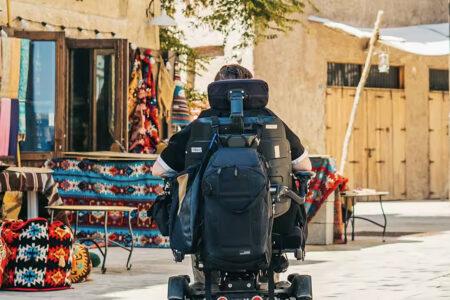
Kathryn Johnson, Director of Partnerships and Policy: Center for International Disability Advocacy and Diplomacy at St. Cloud State University, is an expert in access in Asia and the Middle East.
“The U.S. has been viewed as the model of accessibility worldwide. The Americans with Disabilities Act leads the global discussion on disability policy, but without the U.S. ratifying the U.N. Convention on the Rights of People with Disabilities, our ability to share and model best practices is greatly limited,” she says. “The U.S. can still learn from other countries who are actually doing a better job in certain areas of accessibility.”
Kathryn notes that China, despite being an ancient land, far exceeds accessibility in high-speed train travel when compared to the United States. The rail system connects 31 of the nation’s 33 provinces, and tracks extend more than 40,000 kilometers.
“Trains have designated seating areas, accessible toilets, and specialized aids to assist with pre-boarding and exiting of the train and rail station,” says Kathryn. “The high-speed rail system has leapfrogged the ability for people with disabilities to travel across China during the last 10 years.”
Hosting the 2008 Paralympics provided China an opportunity to increase accessibility at historic locations such as the Forbidden City and Great Wall.
Unfortunately, access often ends at the station door. “The challenge is when you leave the train station, the overall accessibility of the country outside of the largest cities is very limited,” says Kathryn.
Dubai earns praise from Kathryn for its fully inclusive and accessible buildings, schools, transportation rail systems, public transport and communities. She says this level of accessibility “provides an opportunity to lead the world.”
India Slowly Embraces Visibility
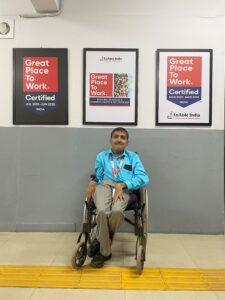
Sayomdeb “Den” Mukherjee, Senior Manager of EI Lab at EnAble India, is an advocate and top-rated radio jockey. He also starred in the 2019 film One Little Finger. Until his rare genetic disorder — Dopamine-responsive dystonia — was diagnosed and treated, he did not have the ability to speak for the first 25 years of his life.
EnAble India is based in southern India’s Bengaluru tech hub, focusing on job training and placement. The organization impacts more than 325,000 people with disabilities and their families.
“I was born in 1980 and my first decade of life, people had no idea about disabled people in India. I was invisible by being visible,” says Den. “Globalization touched India and brought drastic change in the 1990s when I was a teenager. The disability context started to change with economic growth. Districts had nonprofits working for the disability sector – for the first time, we became visible.”
Den traveled much of India with his parents, attended a school for people with disabilities and communicated via an augmentative or alternative communication board.
By the new millennium, he encountered people with the mindset to create accessibility.
“Education for people with disabilities grew, even though many schools were inaccessible. But it was wonderful to feel my classmates, to appear for examinations,” says Den. People with disabilities began to have aspirations. I got greedy – I wanted my own livelihood and everything I could have. Who would think a person who could not speak for the first 25 years of his life could become a radio jockey.”
Accessible India Campaign
In the past decade, India passed a disability act that required more compliance, created job opportunities and codified criminal penalties for harassing people with disabilities.
The new prime minister started a project called Accessible India. He said all central government properties must be accessible — a work still in process — and mentioned disability in his speeches. “It makes an Impact when your prime minister talks about disabilities — he was first ever,” says Den.
Previously it would have been almost unthinkable for Den to leave his native Kolkata. Yet he has relocated more than 1,000 miles to Bengaluru to work for an organization that has placed more than 60,000 people with disabilities into the workforce since its 1999 founding.
For more #GAAD coverage, read Adaptive Technology Equals Independence for the Disability Community and Digital Inclusion and Technology are Fundamental Human Rights. Learn more about United Spinal’s Tech Access Initiative. Join our Tech Access Connection Facebook Group and our monthly Tech Talk event. Join us by signing up for a free membership. To support our mission, donate here.