- When Julie awoke in the hospital after her spinal cord injury, she thought she was in prison.
- Until she found a solution, Julie’s unrelenting pain was tough to navigate.
- Julie has a message about accessibility for all health practitioners.
- Explore our partners at the Model Systems Knowledge Translation Center‘s database for more specific information on spinal cord injury.
Young Julie’s friend took a country curve too fast while driving from Kenosha to Lake Geneva in Wisconsin on July 5, 1980. The car flipped three times, throwing both girls from the vehicle.
Julie, 19 at the time, sustained a T12 complete spinal cord injury in the accident and somehow was taken to a hospital — but she doesn’t remember. Whether from trauma or the hospital’s prescribed medications, she wasn’t entirely sure where she was for a long time.
“As I slowly emerged at the hospital, I was in complete mental denial about everything. If they would say, ‘you’re in the hospital,’ I would say, ‘no, I’m not — I’m in my office, or I’m in my apartment.’ But I have no memory of that at all.”
Her first conscious memory came sometime toward the end of September. “I awakened with a very foggy brain,” she says. “I thought I was in prison. I was in a huge room with huge windows and three other beds that were all far apart. My bed was right next to the big double door. The door was always open, and the person in the room kitty-corner was probably a criminal because there was a police officer keeping guard outside that door 24/7. I could see him from where I lay.”
She turned 20 while in rehab, staying until right before Thanksgiving.
Challenges and Solutions
About a week before leaving rehab, Julie developed debilitating lower back pain. “As time passed, it got stronger and spread into my hips and the tops of my thighs. It was the worst pain you could imagine. So, I spent my life figuring out the pain, whereas the paralysis was secondary.”
Initially, Julie’s doctors couldn’t help much. “I felt alone except for my orthopedic doctor. He was the only one who explained things to me in ways I could understand.”
He suggested he could alleviate her pain by surgically straightening her spine. “But he did not want to do the surgery until I tried all nonsurgical, nondrug options. So, I spent the next two years trying a pain clinic, acupuncture, and biofeedback, but it didn’t do anything.”
Sometime in 1982, he rebroke her back, removed the screws and springs in her spine and put it all back together again. “Initially, the surgery was unsuccessful, so I learned how to function with pain,” she says. I lived my life totally by the clock because time was my enemy. The longer I was up in the chair, the deeper the pain would become. I scheduled everything around the pain.”
She wanted so badly to have a social life. But anytime she made plans, her pain got in her way. “Then, one day, while I was having a cocktail with some friends, something changed. The pain did not come. In the back of my mind, I was conversing with it,” she says. “I’m like, ‘You should be here by now. Where are you? All right, is cancer in there eating the pain? Is it going to be something worse?’” It was her first pain-free day in four years. Afterward, the pain never came back.
Aging with Paralysis
Today, the issue that mostly plagues Julie is aging with a spinal cord injury. “Now things are breaking,” she says.
Julie tries to keep in shape, so she does most of her own chores, including shoveling snow. “When I shoveled my driveway and back patio, I think I tore stuff in my shoulder, and it’s still that way,” she says.
She’s hurt her shoulder before, which always takes a long time to heal. “Once I felt that pain, I didn’t do anything. I didn’t vacuum, and I didn’t get in and out of my car. I’m pampering my shoulder and taking really good care of it.”
She can tell it’s improving, but it still aches. “When I get up in the morning, I feel like the tin man. So, I move it real slow to try to get that pain out of there.”
This video from our partners at the Model Systems Knowledge Translation Center shows shoulder exercises that may help manage shoulder pain:
Back in the Pre-ADA Dark Ages
Everything was harder for wheelchair users before the advent of the internet and the passage of the Americans with Disabilities Act. “I can’t even express the sadness that I felt,” says Julie. “Sometimes, I wish I could speak to myself back then because I really was lost. In the 1980s, we did not have accessible computers and didn’t have support groups. We were alone. We didn’t even have accessible parking spots. Because I never knew anybody in a wheelchair, I just felt, ‘Where can I go with this? Where can I live?’”
Accessibility was rare before Congress passed the ADA. “My way of coping with accessibility issues was to tell myself, ‘Well, this is just how it is. I have to accept this,’” recalls Julie. “I knew I couldn’t go to people’s houses. I knew I couldn’t go to some businesses. That was just my life. I didn’t like it, but there was nothing I could do about it. I told myself to “just be happy with what you got. Be content in every circumstance.”
Julie recommends these three tips for dealing with a new disability:
Remember that everyone struggles. “You’re going to have your pain because you are experiencing a loss. But there is life beyond. Don’t think you’re different from everyone else on the planet because everybody’s struggling with something. Yours is just far more obvious and in your face, but that doesn’t mean you’re alone. Today, things are far better than in the 1980s, and you will not experience access issues. If you do, there are laws to address the problem.
Protect your bones. “I also recommend paying close attention to your ankles. Make sure they sit level. Do what weight-bearing you can to prevent a future of osteoporosis. Because if you don’t, bone density problems will come. I’ve twice fallen and broken a leg, which probably wouldn’t have happened if I hadn’t had osteoporosis. Even though weight-bearing may be painful and a struggle, do it. Your future self will thank you for it.”
Pay attention to those doors. “I’m not a tattoo person, but if I were, I would probably have one that says ‘equal access’ on my forehead. Many places in the community still don’t have that 36-inch width on doors, which I use as a metaphor for all access.”
A Note for Healthcare Practitioners:
Julie is frustrated by healthcare practitioners who refuse to take accessibility seriously. “Why are doctors and medical professionals so blind to our struggle? I’ve had to climb up, lift myself onto the arm of my wheelchair, and then drag myself onto the exam table,” she says. “I’ve fallen a number of times.”
Some at her local hospital don’t even demonstrate an understanding of basic access requirements. “I asked one doctor, ‘Why don’t you have ramps? The doctor said, ‘Oh, we can’t do ramps. Ramps would be very dangerous.’”
Plus, much of the medical and diagnostic equipment can’t be used easily by her at all. “It’s more designed for the operators and technicians,” she says.
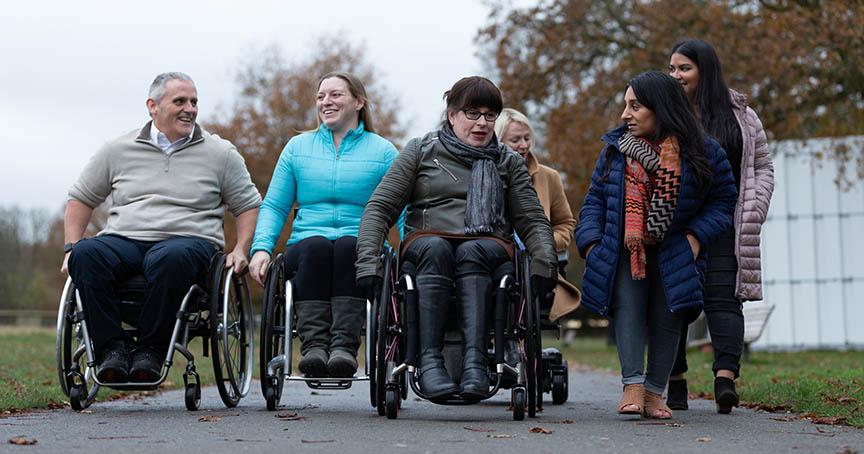
The photo at the top of the page was provided by the Getty Disability Collection. Please contact our Community Support team for more information about United Spinal’s chapters and programs. Join us by signing up for a free membership. To support our mission, donate here.