Today is International Women’s Day.
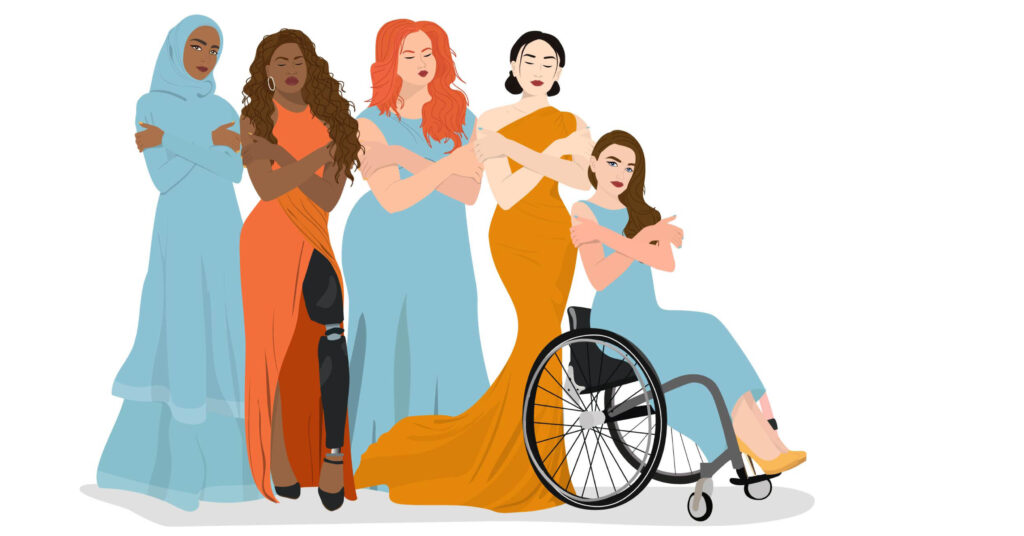
It is a global celebration of women’s social, economic, cultural and political achievements. It is also a call to action to accelerate women’s equality. United Spinal is proud to have many incredible disabled women on our team. They are trailblazers. They are mothers. They are directors. They are change makers. They are advocates.
We asked five of them to reflect on their experiences.
When do you feel empowered as a disabled woman, and when have you struggled?
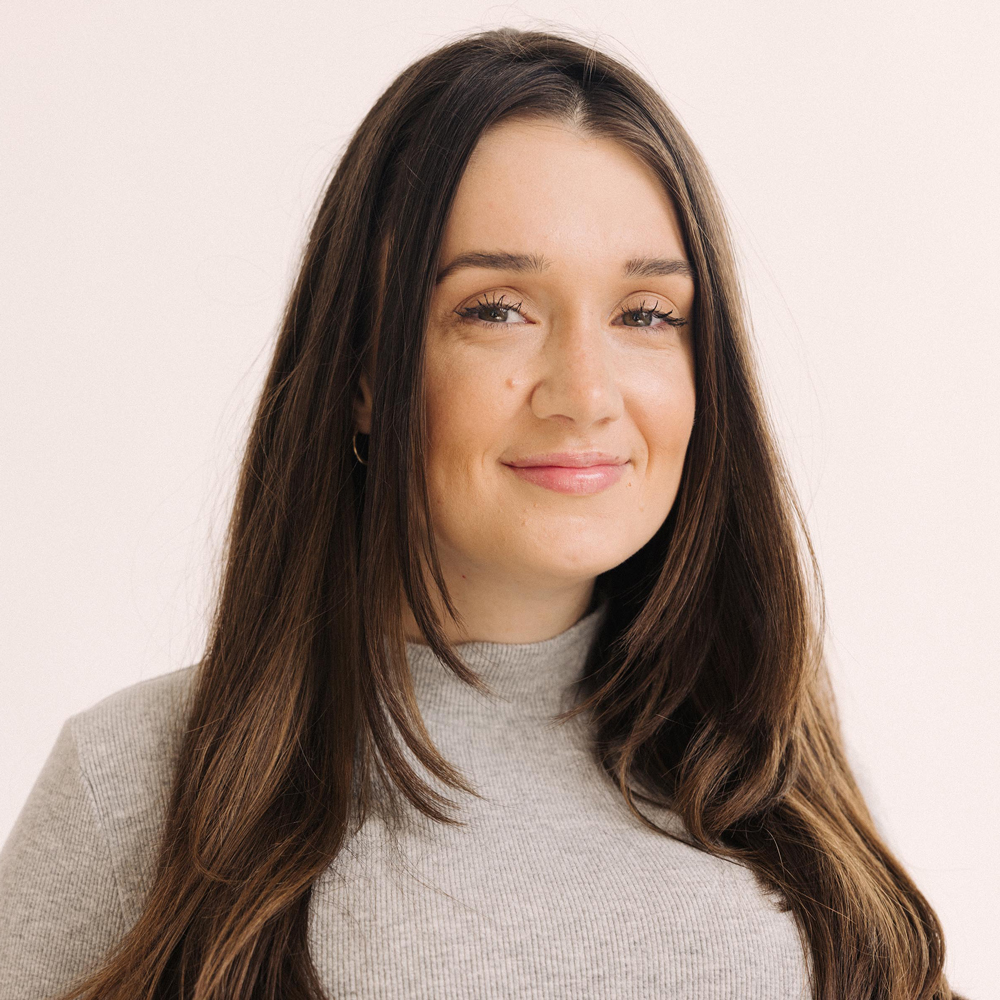
Erin Gildner — Director of Chapter Relations: I attended a panel on health equity for the CDC that included respected physicians discussing racial and ethnic disparities in maternal health. But there was no mention of disability or the intersectionality of multiple identities. When it came time for questions, I asked if they ever considered disability in their discussions about health equity. I discussed the discrimination, bias and trauma I faced during my pregnancies and my children’s deliveries. Everyone on the panel was surprised by my comments and spoke honestly about never considering disability. That was a pivotal, empowering moment in my life and has since allowed me to be involved in conversations about disability and maternal health equity.
Monica Wiley — Board Member: I always feel empowered because I know who I am, and I’m more than my physical disability. I walk, wear heels, and enjoy what life has to offer. Often, when I’m attending a gathering or participating in a community event, people come to me and say, “You have such a positive and peaceful disposition. I’m encouraged by your tenacity and resilience.”
Black women have been told we have an attitude problem, are hard to coexist with at work, and are too loud and overbearing. Because of racism and sexism, we are consistently undervalued and excluded. These specific biases target us for systematic poor treatment, undermine our ability to advance in our professions and wrongly discredit our fight for social progress.
Hilary Muehlberger — Administrative Assistant: Until I competed for Ms. Wheelchair America, I wasn’t aware of just how many women use wheelchairs. For the first two years after my injury, I didn’t want to identify with the disability community. I was so grateful to meet my sisters at MWA Nationals. They understand when I am having a tough day and don’t want to live in the solution yet. I just want to vent and be heard.
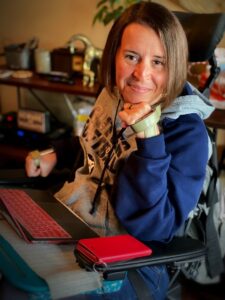
Annie Streit — Grassroots Advocacy Manager: I have used a power chair for almost 18 years. I realize that I am more confident about my purpose than I ever was walking on two feet. Maybe that is because of age and maturity or because I have learned to adapt. Perhaps it is the love and support in my life or a combination of all of those.
I feel the most empowered when sharing my experiences of navigating through life from a wheelchair with others. Whether on a stage in front of 100 people, or one-on-one with someone struggling to find their way, I embrace every opportunity.
I still struggle with asking for help and the loss of independence, but I have learned to embrace the independence I do have. My disability does not detract from my character, drive, and ability to live a happy and rewarding life. Everyone has bad days. It is the bouncing back and continually pushing forward that is important.
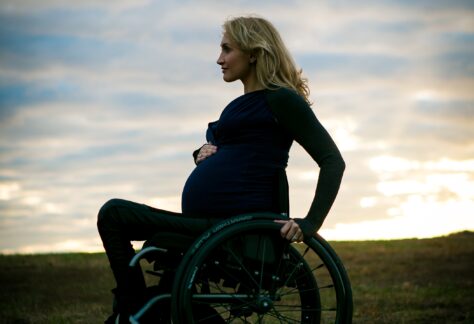
Teal Sherer — Social Media Manager and Writer for New Mobility Magazine: I felt the most empowered when I was pregnant and gave birth to my son, who is now 8! I also feel empowered when I am engaging with other disabled women. A highlight of my week is working out with my personal trainer Christina Chambers, who is also a wheelchair user.
Who is a woman with a disability that you look up to?
Erin Gildner: There are many women in the disability community I look up to, but one person who immediately comes to mind is Reveca Torres. Reveca is such a talented artist, and I’m impressed with everything she does to empower and support the SCI and broader disability community through her nonprofit, BACKBONES.
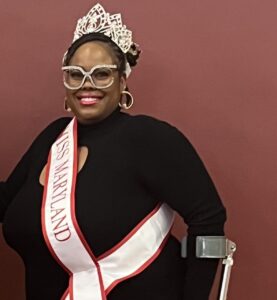
Monica Wiley: Congresswoman Ayanna Pressley. She’s courageous, tenacious, resilient, confident, and unapologetic about who she is. She is dedicated to lifting up the voices of underserved and underrepresented communities. She sponsored the Financial Services Racial Equity, Inclusion and Economic Justice Act, supported the Reduce Violence Against Individuals with Mental Illness and Disabilities Act and co-sponsored the Reproductive Health Care Accessibility Act. It is my desire to meet her and have a conversation about eliminating the stigmas and misconceptions of Black disabled women in America.
Hilary Muehlberger: Ashley Cabrita, Ms. Wheelchair Rhode Island 2019. This woman helped me through some of my most challenging days. With a whole country of distance between us, she still makes sure I feel her love. She set the standard for me as a woman wheelchair user who works, spends time with family and enacts change. She shows the world that nothing will hold her back by simply being who she is. Every day I hope to be a little more like her.
Annie Streit: You cannot think of disability rights and not think of Judy Heumann. The Washington Post said it best: “She’s considered the mother of disability rights — and she’s a badass.” She broke down barriers for the disability community.
Teal Sherer: One woman in the disability community I admire is Lauren “Lolo” Spencer. I wrote a feature on her for New Mobility. She’s an incredible actress and content creator that talks about disability in a way that is raw, authentic, and fun.
What issues that impact women are important to you?
Erin Gildner: I’ve noticed that women with disabilities are often missing from International Women’s Day discussions and celebrations, and it’s a shame. We must amplify each other’s voices and push for greater representation and inclusion in the broader women’s rights movement and society. It’s up to us to raise awareness about disability rights, accessibility, and ableism. These issues are often overlooked or marginalized within mainstream feminist discussions.
Monica Wiley: We need the freedom to make our own decisions about our reproductive health. Equal Pay is crucial, as women are paid 84% and 77% of every dollar paid to white men. Black women are paid 67% and 64% of every dollar paid to white men. People with disabilities earn only 66% for every dollar earned by their nondisabled counterparts.
More than one in five women in the United States experienced a mental health condition in the past year. Many mental health conditions affect more women than men or affect women differently than men.
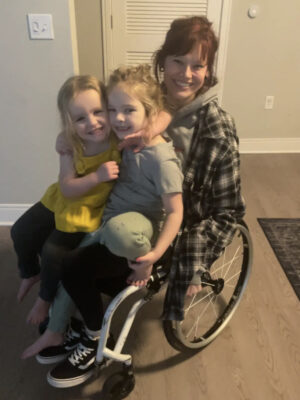
Hilary Muehlberger: We need to be the change. We must lift each other up instead of pushing each other down to get what we want. We are a strong and empowered force to be reckoned with when we work together.
Annie Streit: I firmly believe there needs to be more respect and equity in the workplace — especially for disabled women. Some may think that, as a quadriplegic woman, I experience double discrimination. I see it as an opportunity to work hard while embracing my gender and disability. They are strengths that do not hinder my ability to have a successful career. Although I am not oblivious, that must be a vast improvement in how women are viewed as leaders in their fields.
Teal Sherer: I speak to medical students about healthcare disparities for people with disabilities. Women wheelchair users are less likely to get gynecological exams and mammograms and get diagnosed with cancer. I recently was prescribed the wrong dosage of an important medication because the scale in my doctor’s office wasn’t accessible, and I had to ‘guess’ my weight.
Why is International Women’s Day important to you?
Erin Gildner: International Women’s Day is an opportunity to raise awareness about the experiences of women with disabilities. It highlights the need for greater inclusion and accessibility in all aspects of society. Also, it’s a chance to connect with other women, share our stories, and advocate for disability rights.
Monica Wiley: International Women’s Day is a day that empowers and cultivates the diversity of our collective voice to engage in meaningful impact. It is an opportunity to globally recognize and honor women for the contributions we make every day in society.
Hilary Muehlberger: It reminds me to thank the other women in my life for being people I look up to and admire. They are the example of what I could be, and that helps me achieve my goals. I would be nowhere without my girls, and I hope every one of them knows how proud I am to call them my sisters.
Annie Streit: This is a day to embrace and celebrate being a woman and our achievements across the globe while also raising awareness of women’s rights. The first International Women’s Day took place in 1911, and I am beyond thankful to all of the women before me who bravely stood up for their rights and blazed a path for future generations.
Teal Sherer: Even though being a disabled woman isn’t always sparkles and roses, I LOVE IT. So, I’ll take any chance I get to celebrate and lift up women.
United Spinal Association is the largest disability-led membership organization in the nation. We are dedicated to enhancing the quality of life for America’s 5.5 million wheelchair users. Contact our Community Support team for more information about our chapters and programs, and join us by signing up for a free membership.