The Rolling Renovator
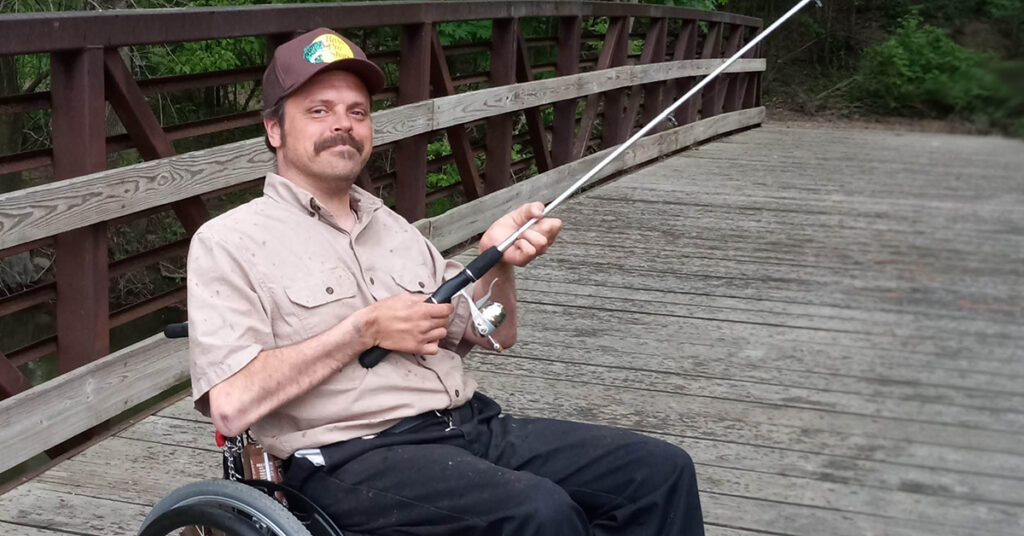
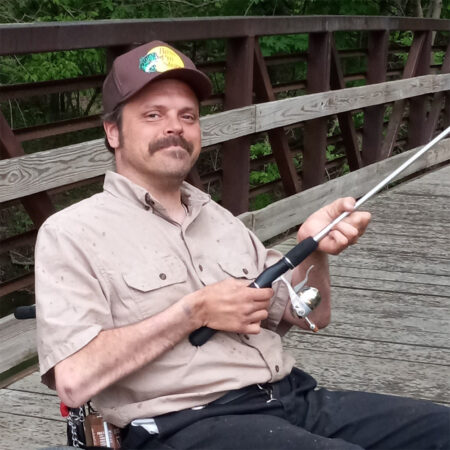
Growing up in Michigan, Joseph Ouellette dreamt of three future careers: Olympic wrestler, horse-mounted park ranger or master carpenter. When a backyard wrestling move resulted in a C4-5 incomplete quadriplegia during high school, the master carpenter route seemed more realistic than the others.
Ouellette had worked alongside his stepfather as a carpenter’s apprentice when he was younger and had a good sense of what was involved in the job. Initially, he envisioned a supervisory role where he could direct subcontractors and laborers, instilling his expertise and vision and working within his physical abilities.
As time passed, Ouellette recovered more function than he had expected. He also realized he wasn’t someone who could just tell others what to do; he needed to be in the middle of things. After high school, he went into business as a contractor, handling small renovations and acting as a handyman for nondisabled clients. It wasn’t long before he adapted the process to do the work himself.
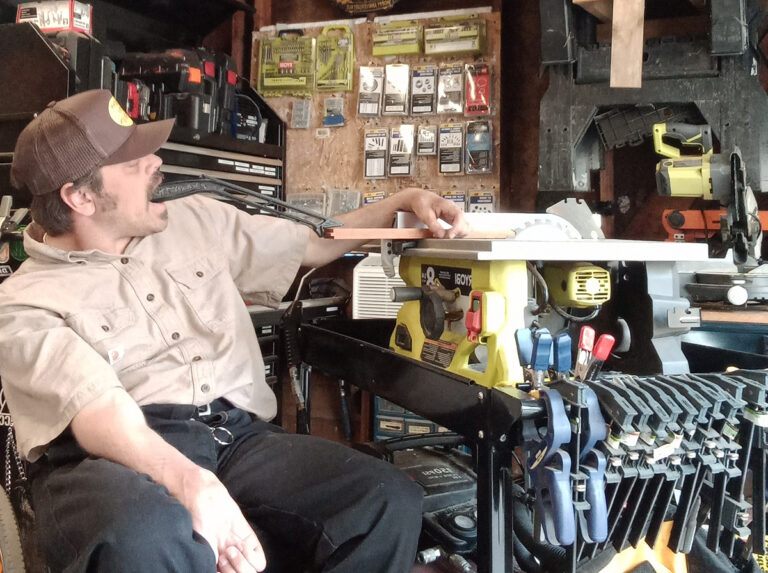
“I have certain tools that are modified for me. On my wheelchair, I have tool pouches and utility pouches,” says Ouellette. “Another example is I’ve adapted my table saw so I can cut wood on my own. The legs are chopped down on the table itself to be at my height level, and I can manipulate my hands to push the wood through the saw blade using tenodesis.”
While Ouellette proved able to do much of the work himself, it took a toll. The physical nature of his labor contributed to 57 spinal strokes between 2002 and 2010. That, combined with work opportunities drying up, brought Ouellette to a crossroads.
“I thought I’d have to retire,” says Ouellette. “However, in that time, I also figured out that it was still OK for me to do contracting work, but if I could set things up differently this time around — where the work would be more consistent and reliable — I could adapt the work to fit my injury better.”
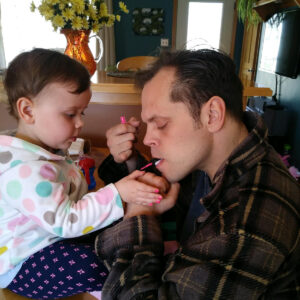 Ouellette decided to pursue a builder’s license, which allowed him to work as a contractor on any residential or commercial building in Michigan. Once licensed, a friend hired him to renovate his home. The work led to more referrals and a new focus.
“That was an open door where I actually thought it would work out this time, so I started focusing more on a niche market of those who just wanted to modify homes and offices for individuals with mobility challenges, including the senior community,” says Ouellette.
Today Ouellette runs Quad Carpentry, a Michigan-based contracting company specializing in accessible renovations. He does all the estimating, materials ordering, measuring and planning himself, while his subcontractors do most of the physical labor. He embraces a “work smarter, not harder” approach but still manages to drill a hole or hammer a nail or two on occasion.
“I really think it’s important for my clients to see me being directly involved. Also, when someone without my direct [disability] experience is involved, clients can often be sold something they don’t actually need.” he says. “I take seriously my level of specific quality control that only I can offer as a person with a disability.”
Racking ’em Up
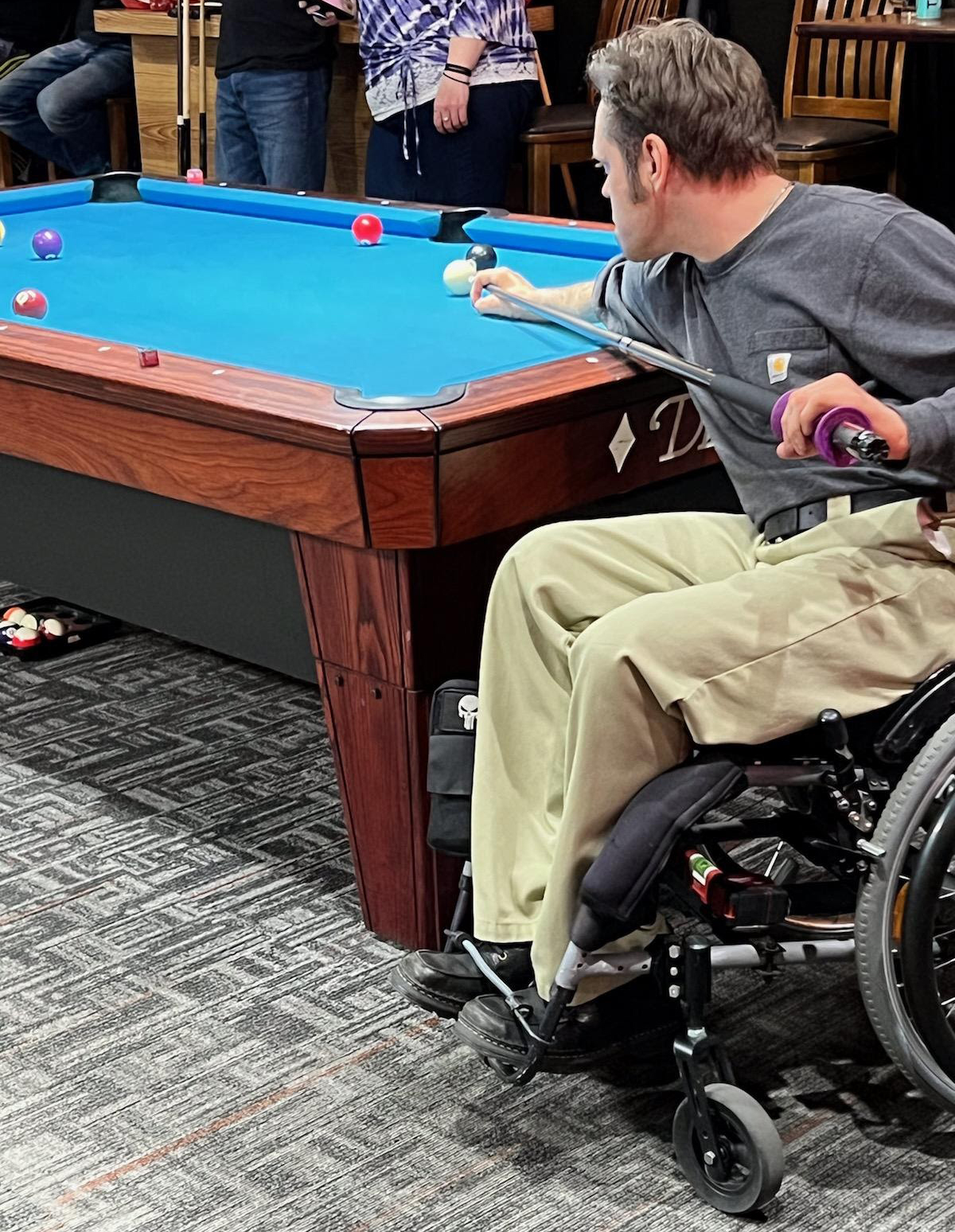 Although he doesn’t wrestle anymore, Ouellette is interested in becoming a paralympic shooter one day and is also on the verge of being ranked in competitive wheelchair pool.
“Before my injury, I used to play pool with my dad at a local hall. I did pick up on it pretty quickly because of my aptitude in carpentry, where you have to have a good eye to see straight lines and angles. I use that same visual acumen playing pool where you have to line up your shot and use different aspects of physics.
After my injury, I’d only play occasionally when I’d be out at a bar, and a friend would be like, ‘Hey want to shoot some pool?’ But I do a lot of peer mentoring for United Spinal Association, and one of the other mentors sent out an email saying The American Pool Players Association was looking for wheelchair players. I play with a team of eight people. We’re called The Smooth Strokers, and there are about 10 teams in the league. I do generate a pretty strong reaction from everybody since I was the only wheelchair player that signed up.”
 Favorite tech device:
My Google home assistant is magic on a shelf. It makes my life much easier from a disability perspective.
Can’t live without:
My van. That thing has had more tools and materials in it than you can imagine, and I’d be nowhere without transportation.
Ever invent a piece of adaptive technology?
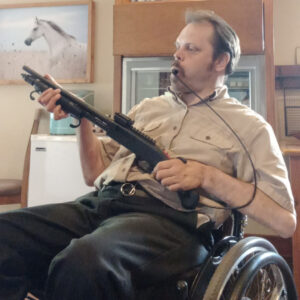
I patented The Fork Tongue Trigger Assist which helps me shoot guns at a paralympic level.
Why did you join United Spinal?
It was important for me to bring a new perspective to helping the newly injured and providing the resources that I learned about through the organization.