
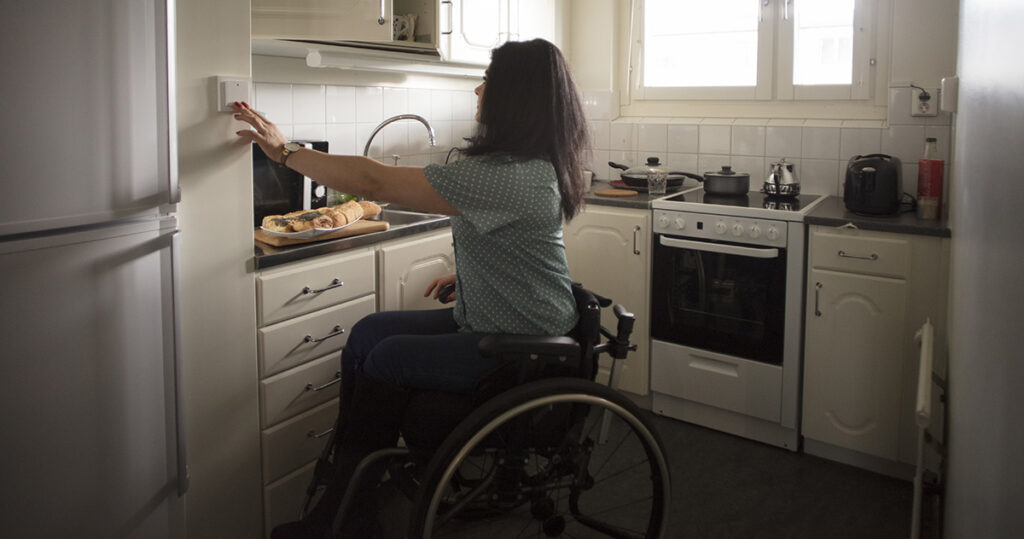
April is Fair Housing Month, and on this occasion, United Spinal Association would like to provide our community an overview of their basic rights to housing that meets their needs—and your options in the event you encounter prejudice during your housing search or your requests to your landlord for accommodation and an accessible environment are refused.
Twenty years after the passage of the Fair Housing Act (FHA), the FHA was amended in 1988 to include disability as a protected class. Republican Congressman Hamilton Fish from Dutchess County, NY and Democratic Senator Edward M. Kennedy of Massachusetts amended the civil rights law to include disability two years before the passage of the Americans with Disabilities Act.
The Act applies to landlords, co-ops and condos, and all multi-family housing, and requires reasonable accommodation and reasonable modifications.
Reasonable accommodations are changes in rules, policies, procedures or services provided in order for a person with a disability to have access to their dwelling place. Examples of reasonable accommodation include allowing overnight caregivers, even though the lease prohibits overnight guests, or allowing a service animal, even though there is a no pets policy.
Reasonable modifications are the alterations to an apartment or home that make the unit accessible to a person with a disability. People with disabilities must be permitted to make these modifications—at their own expense—either to their dwelling unit or to a common use area.
“Reasonable” is determined on a case-by-case basis, and cannot require undue financial or administrative burdens on the housing provider.
The FHA prohibition of discrimination based on disability can be used by tenants confronted with disability-related housing problems to change their physical environment and the policies of the housing provider. For example, a tenant in an apartment building could not be denied permission to ramp, at their own expense, a building entrance, apartment entrance, or common area, such as mail or laundry rooms.
The FHA can be used to change policy, as well. Recently, United Spinal was contacted by the parents of a power wheelchair-using, newly-injured quadriplegic teen. The landlord worked with the parents, in good faith, to try to make the apartment usable for their son, but after several falls and near falls in the bathroom, the parents decided the environment was unsafe. The landlord agreed, but wanted to hold them to the lease, anyway.
The FHA has been used to allow tenants in such situations to break leases without penalties. We convinced the landlord to let them break the lease. Several months later, a bill for several thousand dollars showed up at the family’s new address. The landlord called it a “lease termination fee.” The tenant considered it a disability-related penalty, outlawed by the FHA, and filed a complaint.
Your options in such situations may vary depending on locale. In states with well-developed human and civil rights laws, you may petition a state or municipal commission for relief for disability-related housing discrimination. In localities where you are less protected by local law, you can file a complaint with the US Department of Housing and Urban Development.
Some local laws provide better relief and better protection than the FHA. For example, while the FHA only prohibits landlords from stopping tenants when they want to make reasonable modifications at their own expense, the New York City Human Rights Law has been interpreted to require landlords to pay for the modifications, or at least, share in the costs.
If you think that you have been the victim of housing discrimination based on disability, United Spinal’s Resource Center is always available to field your questions and concerns. The Resource Center also has a wealth of materials on this subject at its disposal, and they’re available to you.
*****
The Fair Housing Act protects people with disabilities who encounter the following:
- Refusal to rent or sell to you because of your disability or your association with a person with a disability—which even entails discrimination against frequent visitors or close friends who are regularly around your house (“association discrimination”).
- Being charged fire fees, extra security, or higher rent because of a disability.
- Refusal to allow assistance animals—even if there’s a “no pets allowed” policy.
- Refusal to permit reasonable modifications, including wheelchair ramps and grab bars.
- Being told you won’t be safe, the neighborhood’s not right for you, or you won’t be comfortable here.
- Terms and conditions change once landlord discovers your disability.
- Waiting an unreasonable length of time for a decision on a housing application.
- Being told the unit you want just rented, even though the space is still advertised.