President & CEO
United Spinal Association
On November 10th, we are celebrating United Spinal Association’s 75th Anniversary Community Event and Gala. I hope you plan on joining us—the Gala is free of charge and all are welcome.
As our year-long 75th anniversary campaign draws to a close, a reflection on United Spinal’s long and storied history and its impact on the present moment is due. Those who came before us still live on in the ongoing achievements of our organization and our community—I hope I can do them justice.
In 1946, United Spinal—then called Eastern Paralyzed Veterans Association (EPVA)—was founded by paralyzed World War 2 veterans in New York. It may seem unthinkable now, but paralyzed veterans returned home victoriously from Europe and the Pacific only to be shunted to the margins of society. Life in peacetime meant subpar medical care, no respite from barriers and other accessibility issues – even at the rudimentary level of housing, and contending with a public that mistakenly believed that veterans’ needs were being met.
Our founders were left with no choice but to organize for their basic rights. They won seminal legislation that provided for accessible housing for disabled veterans in 1948, and twenty years later, the Architectural Barriers Act, which mandated accessible design and barrier removal in federally-funded facilities. EPVA helped plant the seeds of the landmark Americans with Disabilities Act (ADA).
At its height, EPVA was a model cross-generational effort made up of veterans from World War 2, Korea, and Vietnam, united in their conviction to transform the United States into a country where people with disabilities could live independently in the community as full participants in American society, rather than being sequestered in institutions—or worse.
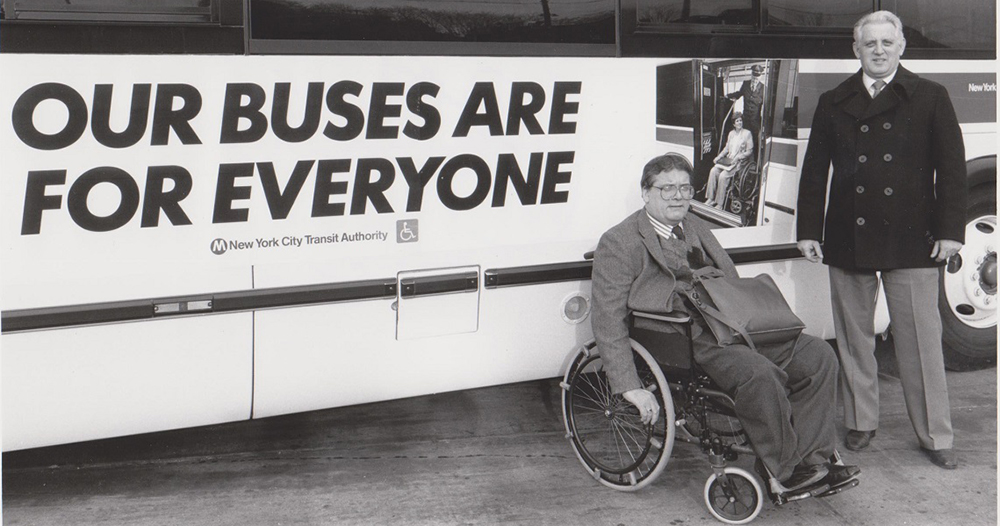
On the eve of Veterans Day and the occasion of our 75th anniversary, I want to pay special tribute to several formative EPVA members whose achievements reverberated well beyond the confines of the spinal cord injury and disorder (SCI/D) community and New York City. James J. Peters, our longest-serving Executive Director, made SCI medicine its own discipline. Terry Moakley (pictured above) made transportation accessible in NYC, setting the standards for the rest of the country, and made accessible design the law in NYC and New York State; his efforts contributed to the codification of transportation training for people with mobility impairments as a genuine profession. Bobby Muller founded Vietnam Veterans of America (VVA) and shared a Nobel Peace Prize for the VVA Foundation’s efforts to ban landmines. Born on the 4th of July was written by an EPVA member, Ron Kovic. And then it all goes back to World War 2 veteran Bob Moss, who founded both EPVA and the National Spinal Cord Injury Association.
Even as the monumental efforts of our predecessors impacted the lives of people with disabilities across the nation, New York City was always our headquarters and the epicenter of our activities.
EPVA’s efforts rebuilt some of the city’s establishments and landscape from the ground-up. Jim Peters’ activism led to an exposé of horrific conditions at the Bronx VA hospital in Life Magazine. The hospital was demolished and the facility that took its place—which is now named after Peters—is now home to world-class research, treatment and rehabilitation for people with SCI/D. Subway stations and buses are accessible because lawsuits filed by EPVA in NYC and later, Philadelphia, in the 1980s became the basis for the transportation provisions in the ADA. Post-ADA, EPVA waged a battle that resulted in NYC committing $1 billion to installing curb ramps at every intersection in the city. Today, NYC’s Metropolitan Transit Authority now has a Chief Accessibility Officer, Quemel Arroyo, who is a United Spinal member. Remaking the foundations of everyday life with the goal of universal, accessible design, and involving people with disabilities in the oversight of these institutions to ensure that this goal is met will always be central to United Spinal’s ethos.
Following this long and often difficult chronicle of struggle, New York is now a model city for wheelchair users. Over the years, I have been fortunate enough to be able to travel around the world, but outside of New York—even in genuine metropolises—I am often faced with challenges owing to a lack of accessibility, such as a lack of curb cuts and accessible taxis. New York is a living reminder of the work our community has left to do. In New York, I feel the pulse of United Spinal’s founders and historic leaders everywhere as I easily traverse city blocks just as if I were walking—and it inspires me.
We need to be guided by the kind of fortitude and faith—and far-sighted vision—that animated previous generations to meet the challenges and inequities that our community continues to face. We suffer underemployment and lack of career advancement on a mass scale, despite advances in remote work and unprecedented attention to workplace accommodation; our families, communities and all of society suffers from our exclusion from the workforce. We continue to experience discrimination and disparities in healthcare, transportation, education, and recreation that demand vigilance and strong, connected organization. Right now, rebuilding our country’s infrastructure and redefining our conception of care is a flashpoint for all of American society, and we are making sure that our community can be effective agents of change in this historic moment.
To have the kind of impact that’s necessary, we need to reach everyone in the SCI/D community who can be reached. When I sustained my spinal cord injury, at first, I felt alienated from my own self, because SCI was such unknown territory for me—and is for the American mainstream. Encountering United Spinal and New Mobility magazine was a godsend in understanding and articulating my “new normal,” but it was also a matter of happenstance. We need to make it so that it is a certainty for everyone in the SCI/D community.
Our founders and predecessors built durable and powerful community with real social leadership under much quainter circumstances. Now, we can utilize the connectivity of the internet (and United Spinal is engaged in advocacy for universal broadband and improved access to affordable technology, so nobody is left out) and a cadre of community members and allies in politics and the private sector developed over years of advocacy to help gather our forces and represent our concerns on the issues that affect us.
Speaking as a United Spinal member, I am keenly aware of how this moment has been 75 years in the making. Though we are engaged in work our predecessors would not have previously imagined, thanks to the inexorable forward motion of the tech revolution, the urgency of climate change, and the tragedy of the COVID-19 pandemic, the mission that they established timelessly applies. The committed base they built remains indispensable even today. While the composition of the organization has changed in leaps and bounds since opening membership to all people with SCI/D in the early 2000s, their legacy—especially the legislative and regulatory building blocks of the ADA—will live on into and shape the next 75 years.