
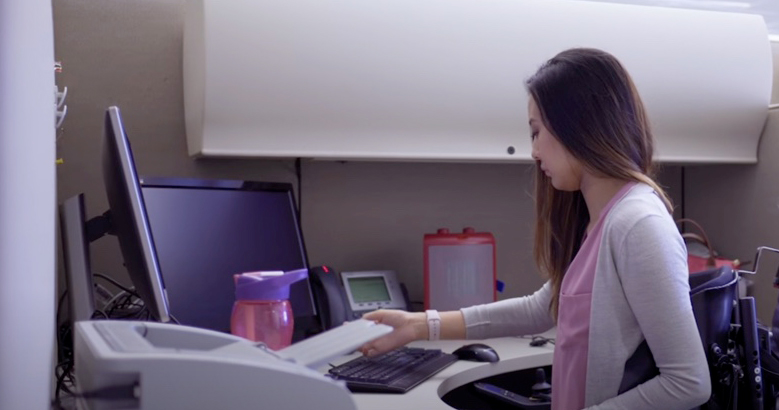
Above photo courtesy of What It’s Like to Navigate Chicago in a Wheelchair video
Q&A with United Spinal’s Program Director Michele Lee
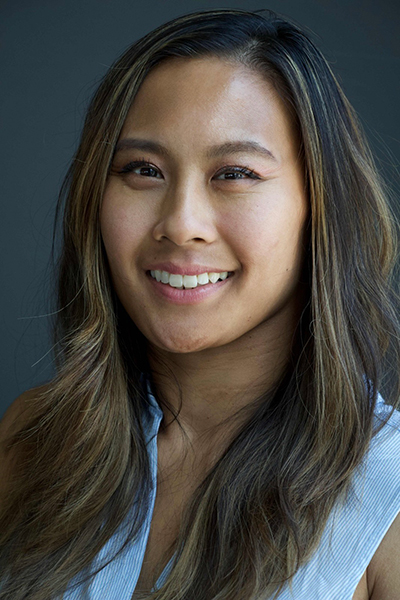
In honor of National Disability Employment Awareness Month, United Spinal’s new Program Director Michele Lee shares her perspectives on pursuing a rewarding career as a wheelchair user.
Michele became a quadriplegic and power wheelchair user after a spinal cord injury in 2003. But that did not stop her from reaching her professional goals. She has over 10 years experience working in finance and corporate treasury. Michele is also a disability advocate, fighting for disability inclusion in the workplace and universal access to transportation and healthcare. She graduated with a Marketing and Communications degree from the University of Arizona.She is based in Chicago and has been a longtime member of United Spinal and contributor to our Tech Access Initiative.
Michele will oversee our Ready to Roll, Pathways to Employment and VetsFirst programs and we are very excited to see her take them to the next level.
Tell us a little bit about yourself and how you became involved with United Spinal.
I grew up in the Chicago area and went to college in Arizona, where I injured my spinal cord in a car accident two days before graduation. I have a C6 level spinal cord injury which makes me a quad. I use a power chair to get around. After my injury, I came back to Chicago to be near my family and complete rehab at what is now the Shirley Ryan AbilityLab. It was there that I first heard about United Spinal Association and became a member.
More recently, I have become more involved in the Tech Access Initiative. I have a love-hate relationship with technology as it is both frustrating and empowering. I see a lot of potential for technology to enable independence for people with disabilities: think wheelchair accessible autonomous vehicles. In my career, I have over ten years experience in working at a large financial services firm, where I became very involved with disability advocacy and founded a disability-focused Business Resource Group. Most recently, I made the decision to pivot my career to join the United Spinal team and focus on my passion, supporting people with disabilities to get hired and promoted.
What do you think are the biggest myths about reentering the world of work as a person with a disability that you would like to dispel? What are the expectations you’d like to raise among people in the disability community about job seeking and advancement on the job?
One of the biggest myths about re-entering the world of work after injury is that it is scary and impossible. At first with a spinal cord injury, everything is overwhelming. Relearning how to get dressed is a challenge and sometimes thinking about going back to work is even scarier—but with technology these days, and more and more remote work opportunities available, anything is possible. At the same time, it’s important to have realistic expectations.
In the current job market, getting an interview and getting your resume in the door is seen as half the battle for everyone, not only people with disabilities. It’s important to be confident in your skills and the work that you are able to do. Also, learn to frame your disability in a positive light. For example, every single time I need to leave the house it requires extensive research around wheelchair accessibility and flawless coordination of transportation—that speaks to my organization skills. I believe in letting your work speak for itself and promotions will follow.
Making strong and trusting connections with others in the community is an important first step on an employment journey. What should people with disabilities expect from a mentor from the community who is working with them on their employment journey, and what guidance should they prioritize looking for as they rejoin the workforce? How does the mentorship process mature and transform after securing employment?
It’s easy to look at other people and compare yourself. no two people are exactly the same and no two spinal cord injuries are exactly the same. Having mentors and connections in the community is absolutely important, but it’s easy to see what others are doing and feel that you are not doing enough. We are all on our own journeys in our own time. With that said, finding mentors is crucial for employment. Find mentors who are might be working in a field that you would want to do yourself. Don’t hesitate to leverage your mentors and their networks. They may know someone who knows someone who is hiring. The mentorship process is always evolving and sometimes your mentor may become your mentee, depending on what situation you might find yourself in. But don’t forget your connections as you grow in your career: stay in touch as much as you can.
Accommodation requests are highly personal and always unique, and can be received quite differently depending on the circumstances. What are some pointers you can give the community from personal experience on having your needs met by your employer—and what are the essential tools that you think employers should have at their disposal to ensure that they can meet the needs of all of their employees with disabilities?
Accommodations can be a scary word for a company or employer. Try to look at circumstances from the point of view of your manager or boss. A person with a disability, you know your own disability the best but your manager or boss might be completely unfamiliar. Being transparent about your limitations is helpful. Also, think about how you can get what you need done with the least amount of resources. Finally, it’s important to be open to the process of trying different things. Finding the right accommodation is an iterative process and might require some patience and take some time.
Tell us a little about what you think are the elements of a successful Business/Employee Resource Group?
A successful Business or Employee Resource Group really has to be a resource for the organization in addition to being a safe space for colleagues with disabilities and allies of people with disabilities to connect and collaborate. Ideally, it acts as an advisory group for all things disability-related. For example, if hiring managers or colleagues have questions or concerns around accommodations and accessibility, the Business Resource Group should be able to provide resources and maybe personal perspectives from colleagues. I believe that Business Resource Groups should also be consulted for talent and recruiting, and encouraging and advocating for more people with disabilities getting hired and promoted.
Building solidarity with coworkers without disabilities as a person with a disability—while being treated as an equal—can mean striking a complicated balance between representing yourself as a person with a disability on your own terms and asserting your rights and personal agency, while not being pigeonholed as a person with a disability. What are some tactics and messages that can be utilized in negotiating this balance?
It’s always a good idea to connect with others along lines outside of disability in order for coworkers without disabilities to see we are so much more than our disability. We all have complicated identities outside of our disability identity. Once people see the whole person in addition to the disability, it is easier to navigate the complicated balance between representing yourself as a person with a disability on your terms and asserting your rights and personal agency while being treated as an equal.
In terms of the bigger picture, what are the most important contemporary changes to the US economic landscape and labor market that could benefit workers with disabilities? How can nonprofits and government agencies help capitalize on those trends to serve our community better?
I think the move towards flexible work schedules and remote work is hugely beneficial for people with disabilities. But in terms of the bigger picture, there are a few contemporary changes to the US landscape and labor market that could hugely benefit workers with disabilities. For example, in addition to affordable child care, affordable personal care attendants need to be readily available to workers with disabilities. In order for me to work an 8-hour day I require a caregiver to help me in the morning and the evening. It is not cheap to find reliable dependable quality care. Caregivers need to be recognized and afforded benefits like paid sick time, healthcare benefits and the ability to contribute to a 401k. Without my team of caregivers, I would not be able to successfully work.
Outside of the workplace, what are other areas of disability rights advocacy that you think are critical for the success of our community?
I believe transportation and universal access to accessible transportation is an integral part of the success of our community. If we cannot get to workplaces or doctor’s appointments independently, how can we be successful? We need more advocacy around transportation. Uber, Lyft, taxis, and public transit systems need to offer equal services for everyone regardless of disability.